


At a glance
“Coal generation in OECD countries falls below half of its peak,” by Dave Jones. Ember. Sep 30, 2024.
The last coal-fired power station in the United Kingdom, Ratcliffe-on-Soar, shut down at the end of September. It was marked as the end of an era for the U.K., but this report from independent global energy think tank Ember examines the rapid decline of coal power generation across other wealthy countries. Using annual electricity generation data compiled by Ember, the report says 14 of the 38 countries in the Organisation for Economic Co-operation and Development (OECD) are now coal-free. Coal generation among OECD members has plummeted by 52 per cent since its 2007 peak, now accounting for only 17 per cent of total electricity. The report says renewable energy growth, primarily wind and solar, is driving 87 per cent of this reduction. Nearly three-quarters of OECD countries are on track to phase out coal by 2030. Since coal combustion produces significantly more greenhouse gas emissions than other fossil fuels, this trend sets a precedent for how industrialized countries can decarbonize and lead the global energy transition.
Key findings
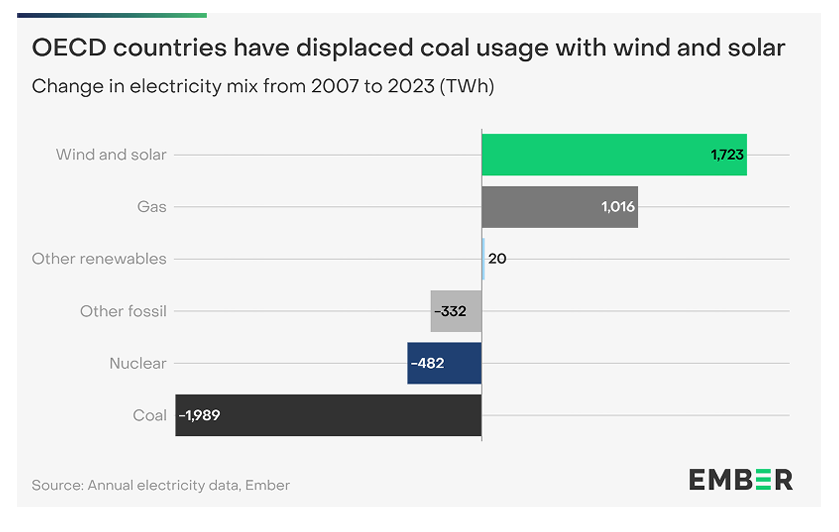
- Coal generation plummeting: Coal generation in OECD countries has fallen by 52 per cent since its peak in 2007, dropping from 3,854 TWh to 1,865 TWh in 2023.
- Renewables replace coal: Wind and solar accounted for 87 per cent of the decrease in coal generation, growing elevenfold (+1,723 TWh) from 2007 to 2023.
- Coal-fired electricity falls: Coal’s share of total electricity generation in OECD countries declined from 36 per cent in 2007 to just 17 per cent in 2023.
- Coal-free nations grow: 14 out of 38 OECD countries are now coal-free, with the U.K. being the latest to join that list after closing its last coal power plant in September 2024.
- Targets within sight: Nearly three-quarters of OECD countries are on track to phase out coal by 2030, aligning with global climate goals.
- Backsliding in Türkiye: Despite the overall decline, Türkiye set a new coal generation record in 2023, becoming the second-largest coal generator in Europe after Germany.
- Gas competes with renewables in the United States: The U.S. was the only OECD country that saw a large uptick in gas; wind and solar generation replace coal in 47 per cent of the U.S. coal phaseout but gas covers most of the rest.
Take a look
Bigger picture
The U.K. was home to the Industrial Revolution and with it, the first coal-fired power plant in the world. It was not until the 1990s that coal began to shrink as a share of the country’s electricity mix. The phaseout of coal, initially sparked by a shift to natural gas and then growing concern over the impact of greenhouse gas emissions on climate change, picked up speed over the past decade. Coal disappeared completely from the U.K. grid with the recent closure of Ratcliffe-on-Soar, the last remaining coal-fired power station. The U.K. story is not unique, as the 2015 Paris Agreement also helped build the momentum for the shift away from coal in other countries. By highlighting the significant progress made by OECD countries in particular, the Ember report challenges the notion that fossil fuels are essential for prosperity. It also shows how high-income economies can lead the clean energy transition without compromising economic growth or energy reliability.
This could set a powerful example for countries such as the United States and Japan, which have pledged to move away from unabated coal-fired plants but still use them now. There are also lessons for China and India, which the Global Plant Tracker says are responsible for 86 per cent of new coal-power development. By showcasing the potential of renewables to replace fossil fuels cost-effectively and at scale, the report could inform climate negotiations and international development strategies and keep the phaseout pressure on.
The transition may not be easy. As coal plants close, industries such as mining, transport and manufacturing face disruption, so economic diversification and workforce retraining are needed. But at the same time, the surge in wind and solar adoption creates opportunities for technology companies, battery manufacturers, and grid developers, redirecting capital towards clean energy projects. The success in OECD countries signals that renewables are competitive and scalable. This could influence global energy policies and trade agreements.
Challenges and opportunities
Key barriers to eliminating coal generation from OECD countries identified in the report:
- Lack of explicit coal phaseout commitments: 11 OECD countries have not yet committed to a 2030 coal phaseout, hindering coordinated efforts.
- Slow clean energy deployment: Countries like Japan and South Korea have seen limited build-out of clean power, impeding their ability to replace coal.
- Rising electricity demand: In some nations, like South Korea and Türkiye, rapid demand growth has outpaced clean energy expansion.
- Insufficient grid infrastructure: The report implies that inadequate transmission and distribution systems may be limiting renewable integration in some areas.
- Policy inconsistency: While not explicitly stated, the varying progress across OECD countries suggests inconsistent policy approaches are slowing the transition.
To address these challenges, the report recommends:
- Accelerated solar and wind deployment: Wind and solar have been shown to successfully replace coal in major economies, further acceleration could drive significant progress.
- Regional collaboration: OECD countries could share best practices and co-ordinate phase-out strategies to achieve more uniform progress.
- Demand management: Implementing strategies to stabilize electricity demand growth could help countries like South Korea transition more effectively.
- Targeted support for lagging countries: Policymakers could focus on nations like Türkiye, Japan, and South Korea to accelerate their transitions.
- Integrated planning for 2035 targets: Countries should begin planning for fully decarbonized power systems by 2035, addressing both coal and gas phaseouts simultaneously.
- Innovation in grid flexibility: Investing in smart grid technologies and energy storage could help manage higher shares of variable renewable energy.
In their own words
Coal power is on its way out in the world’s richest economies. It may surprise some that the shift was not primarily to gas, but rather directly to solar and wind. It is encouraging to see mature economies now switch their focus to repowering their whole economy with clean energy, to ultimately close the chapter not only on coal, but on all fossil fuels.
Coal generation in OECD countries falls below half of its peak. Dave Jones, Global Insights Programme Director. Ember. Sep 30, 2024.
Final thoughts
The Ember report reveals a significant decline in coal generation — one of the world’s largest historical polluters — that is primarily due to a dramatic increase in wind and solar energy. It shows that rapid decarbonisation is achievable in advanced economies, but the work is not yet done. Next steps for OECD countries include further expanding renewable energy and phasing out gas power to achieve fully decarbonized electricity systems by 2035. This ambitious target could spur innovation in energy storage, smart grids and carbon capture technologies, but it also raises questions about global supply chains and energy security. The report could therefore have been strengthened by exploring the geopolitics of clean technology. It could also have given more details on how the experience of OECD countries could be adapted to help confront the challenges faced by rapidly growing economies in Asia and Africa.
Download the full report originally published by Ember on Sept. 30, 2024.


